Precision lighting for high-end manufacturing – welight intelligent at DESMA
- Industry solutions
- Blog
- Press
The DESMA Group, a world-leading manufacturer of injection molding machines for elastomers, has launched its...

Short teaser:
The EU has reissued the Building Directive EPBD 2024. This places greater emphasis on energy-efficient lighting and automatic control systems in non-residential buildings. For operators of halls, logistics, production and office spaces, this means: Those who modernize today should not just replace the lights, but also think „smart ready“.
With the revised EU Building Directive EPBD (Energy Performance of Buildings Directive) The EU is sending a clear signal: Buildings must become more energy efficient faster and more consistently – in new construction as well as in existing buildings. Lighting is explicitly taken into account as part of the overall energy assessment of non-residential buildings.
Lighting is one of the major energy consumers in many commercial and industrial buildings – especially where long operating times and high lighting intensities are required. The EPBD amendment makes it clear:
The energy demand for fixed installation lighting is increasingly factored into the overall energy balance of non-residential buildings.
Light renovations are considered „low-hanging fruit“, Because they are quickly implementable and immediately bring measurable savings.
In short: Anyone who needs to improve the energy efficiency of their building can hardly ignore the topic of lighting.
An upgrade from 1:1 to LED or DALI already significantly reduces consumption. However, the EU logic continues: The actual efficiency only comes through control.
The EPBD therefore recommends and accelerates the use of:
Presence/occupancy detection (Light only where people work),
Daylight follow-up (automatic dimming in sufficient daylight),
Zoning (more refined switching and dimming zones instead of „all on/all off“),
Data-based monitoring as part of digital building documentation.
This makes „connected lighting“ the foundation for achieving energy efficiency targets on a lasting basis.
At the same time, the EU is tightening the requirements for Building automation and control systems (BACS). For non-residential buildings:
BACS becomes mandatory, as soon as heating/cooling/ventilation systems Over 70 kW nominal power lie.
Target date for implementation: No later than 31 December 2029.
Even though this requirement formally refers to HVAC systems, in practice lighting is almost always integrated into the overall energy management system – because it can be quickly and reliably reduced in volume.
The EPBD introduces minimum energy performance standards for non-residential buildings. By 2030, these standards are to be met in all buildings. the worst 16% the stock is improved by 2033 at the latest 26 %.
For operators, this means that at least for major renovations, lighting becomes a mandatory component of the energy roadmap – ideally in combination with intelligent control.
Anyone planning or modernizing today should consider two things:
Efficient lights (LED/DALI)
Intelligent, retrofitable control system
This not only creates better light, but also a system that:
Energy consumption is automatically minimized,
the EPBD logic is met,
and remains flexible and expandable over the years.
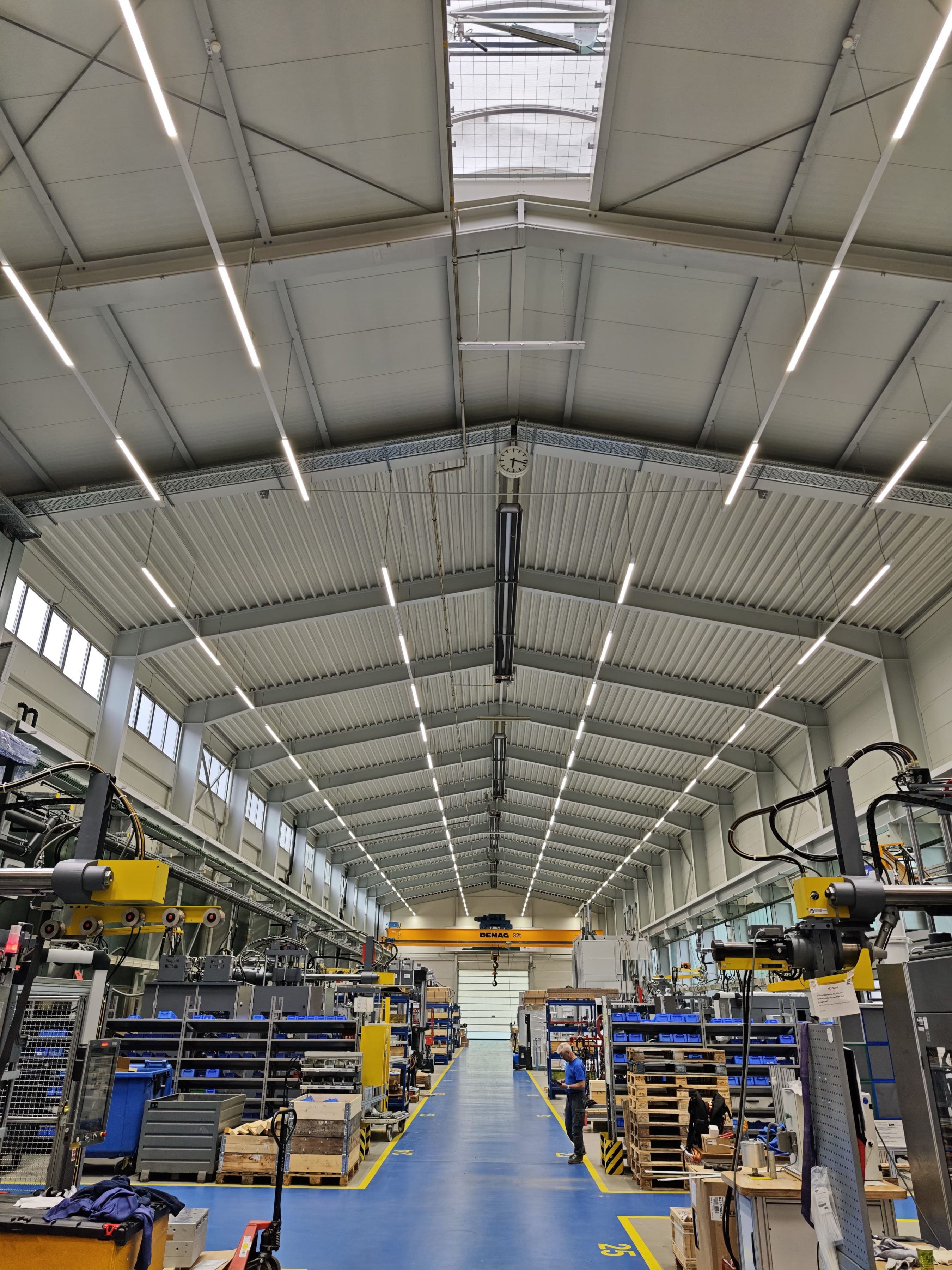
Especially in halls with alternating occupancy patterns, shift work or a proportion of daylight here lies the greatest potential.
The EU requirements make it clear:
Lighting becomes a strategic efficiency lever – and control becomes the standard.
A pure exchange of the lights is a good step. But anyone who wants to invest in the future relies on Smart readiness: zoned, sensor-based and expandable at any time. So a light project becomes a real one. Energy and compliance upgrade.
For those who would like to delve deeper, here is a well-organized overview of EU developments and why light in energy efficiency policy continues to gain importance:
[Tradeblatt article]